Inside SARS’s Risk-Based Model: Segments, Scoring, and What It Means for You
South Africa’s filing season is in full swing, and with it comes the familiar phrase: “The risk algorithms picked up a risk.” For SME owners and finance leads, this can feel opaque. What exactly is SARS’s risk-based model? How does it rank you against other taxpayers? And most importantly—what can you do to reduce unnecessary friction?
This article explains the why and the how of SARS’s model, so you can align your processes, anticipate the likely questions, and keep your business off the radar for avoidable verifications.
Why a risk-based model at all?
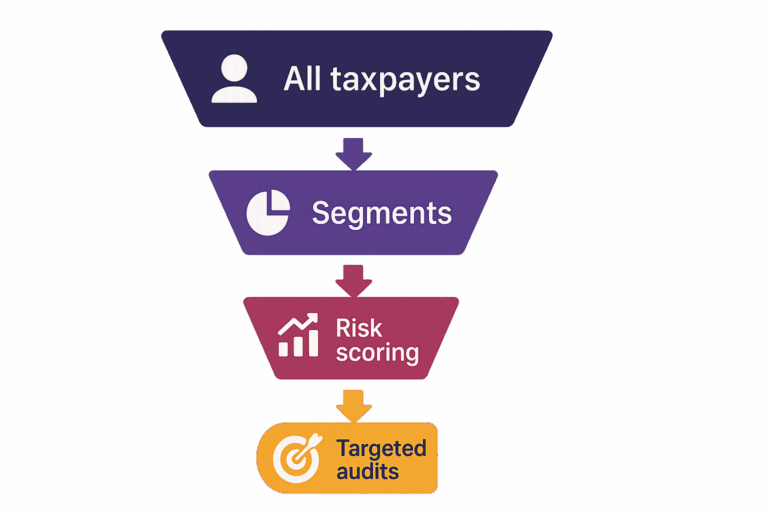
SARS manages millions of taxpayers across multiple tax types. Treating everyone the same would be inefficient and unfair. A risk-based model enables SARS to:
- Segment the taxpayer base into comparable groups (e.g., auto-assessed individuals vs large corporates).
- Target non-compliance where it’s statistically more likely to occur.
- Allocate scarce human auditors to high-value, high-risk cases.
- Reduce burden on lower-risk taxpayers, improving turnaround times.
- Improve fairness by treating like-for-like taxpayers similarly.
In practice, your segment (who you are) and your behaviour (what your data shows over time) combine to determine your audit likelihood.
Lower-risk vs higher-risk profiles
While every case turns on its facts, certain profiles are generally lower risk:
- Auto-assessed individuals: returns based primarily on validated third-party data.
- Third-party-populated returns: minimal manual overrides mean fewer errors.
- Consistent qualifying SMEs: stable operating patterns and steady tax behaviours year-on-year.
Conversely, some profiles require more evidence and scrutiny:
- Expats/residents with offshore income: worldwide income rules + cross-border data exchange.
- Sole proprietors: business expenses lack built-in third-party validation.
- High-net-worth and large corporates: complex financial affairs.
- Farmers, mining, property developers: long pre-revenue phases, frequent VAT refunds, diesel rebates.
- Importers/exporters: customs and movement verification.
Being higher-risk doesn’t mean non-compliant—it means SARS expects tighter documentation and consistency.
How risk scoring evolved: from broad to precise
Before 2019, verification letters often felt generic—asking for a long list of documents whether or not you claimed those items. Risk profiling leaned heavily on past compliance, industry norms, and anomaly detection, with significant human oversight.
Since 2019, AI/ML and real-time analytics sharpened the process. Today you’re more likely to see line-item-specific requests (e.g., only your Section 6B medical schedule, or only foreign tax credit documents). The result: faster assessments, fewer blanket requests, and less admin for compliant taxpayers.
The two-stage control: pre- and post-assessment
- Pre-assessment filters: real-time prompts (e.g., “excessive change in liability”) nudge you to fix anomalies before filing.
- Post-assessment verification: if risk persists, targeted letters request documents specific to the flagged item(s).
Cross-tax linking matters
SARS integrates data across tax types for a holistic view. That means:
- VAT turnover (excl. VAT) should reconcile to ITR14 revenue.
- Payroll costs in your financials should reconcile to EMP501/IRP5 totals.
- Supplier outputs vs your VAT inputs are matched across taxpayers.
Misalignments here are among the most common triggers—and they’re entirely preventable with good reconciliations.
What this means for you (and your team)
- Know your segment: your SIC code, size, and industry shape expectations.
- Manage behaviours: consistency over time reduces noise and questions.
- Reconcile across taxes before filing; keep schedules that prove the linkages.
- Respond precisely: if SARS asks for 6B only, don’t upload your entire life.
- Modernise your internal SOPs: as SARS’s tooling matures, your compliance playbook should too.
If you’d like a practical risk-readiness once-over before (or after) you file, Managing Advancing Wealth (Pty) Ltd can help. We specialise in accounting, tax, company compliance, and business automation, building the reconciliations and documentation packs SARS expects—without burying your team in admin.
Next in the series: (2 of 5) Where SARS Gets Its Data—and the Cross-Tax Recons SMEs Must Nail.
Important Disclaimer
This material by Managing Advancing Wealth (Pty) Ltd (MAW) is general information only and not accounting, tax, legal, financial, or investment advice. Laws and guidance change over time; accuracy is not guaranteed. No liability is accepted for actions taken in reliance on it. No client relationship arises until MAW issues and you accept a Letter of Engagement. For advice tailored to your circumstances, please contact MAW.