Where SARS Gets Its Data—and the Cross-Tax Recons SMEs Must Nail

SARS’s risk engine is only as strong as the data it ingests—and it ingests a lot. Understanding those sources (and how they cross-match) is the single best way to prevent avoidable verifications. This article maps the data inputs and shows you the reconciliations that keep your file green.

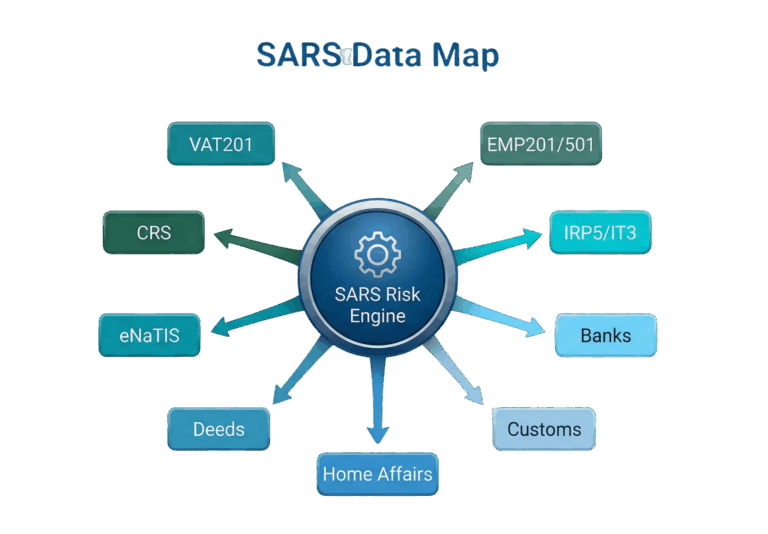
The data map: internal + external

1) Registration details and SIC codes
Your registration profile sets expectations. If your SIC reflects residential letting (generally exempt), routine input VAT claims will clash with that fact pattern. If you indicate commercial letting, standard-rated rules apply. Choose—and maintain—the right profile.

2) EMP201 → EMP501 → IRP5 chain

  • EMP201 is the monthly source document for PAYE/UIF/SDL.
  • EMP501 reconciles the year’s EMP201s and issues IRP5 certificates.
  • SARS expects your financial statement payroll expense to line up with the EMP501/IRP5 totals. Large gaps invite questions about under/over deductions.

3) VAT201
This return reveals your outputs and input claims—including capital vs trading inputs, imports/exports, zero-rated vs exempt supplies. Frequent refunds are normal in some sectors (e.g., agriculture with zero-rated outputs) and suspicious in others (e.g., professional services). Expect scrutiny when your pattern doesn’t match your industry.

4) Third-party data (IT3 series, medicals, retirement, trusts, PBO donations)
These flows pre-populate many individual returns. When your filing mirrors third-party data with minimal overrides, your risk drops meaningfully.

5) Banking and customs
Banks and ports contribute transactional signals. If your VAT account shows months of “no activity” filings while your bank account is busy, expect a nudge.

6) Other government data

  • Deeds Office: links to potential CGT events on property disposals.
  • Home Affairs: identity and status checks.
  • eNaTIS: vehicle type verification (e.g., double-cab vs single-cab vs delivery vehicle).
    These connections help SARS classify transactions correctly (e.g., no input claim on passenger vehicles).

7) Cross-border data (CRS/OECD)
Offshore accounts and financial assets are increasingly transparent via automatic exchange. If you have foreign income, align local filings with foreign tax year details and certificates.

How SARS stitches it all together

Expect inter-taxpayer matching (your input claim ↔ supplier’s output declaration) and cross-tax linking within your own profile. Three must-pass tests:

  1. VAT ↔ ITR14 revenue
    Your VAT turnover (exclusive of VAT) should reconcile to revenue in your income tax return. Document the bridge (timing differences, exempt/zero-rated income, adjustments).
  2. Payroll expense ↔ EMP501/IRP5
    Your GL wage line should mirror EMP501 totals (plus a clear map for differences like directors’ remuneration or provisions).
  3. CGT reality check
    If you sold property, ensure your ITR14/ITR12 reflects the disposal and calculation; don’t assume SARS won’t see it.
SARS Compliance Test

Practical recon pack (build once, reuse forever)

  • VAT-to-Revenue Bridge
    • Trial balance revenue (excl. VAT)
    • Add: zero-rated/exempt disclosures for visibility
    • Less: non-VATable items
    • Tie-back memo: how the VAT201 turnover lines up
  • Payroll Proof Set
    • GL payroll extract (annual)
    • EMP201 totals (monthly table)
    • EMP501 summary and IRP5 count/value
    • Variance analysis (e.g., timing, provisions, bonuses)
  • Supplier VAT Validation Folder
    • Supplier list with VAT numbers
    • Sample of high-value invoices (valid tax invoices)
    • Periodic checks for VAT registration status
  • CGT & Capital Schedule
    • Asset register updates
    • Deeds reference (if property)
    • Acquisition/disposal docs and calculations

The SME reality: where issues creep in

  • SIC drift: business model evolves but registrations don’t—creating VAT treatment conflicts.
  • DIY spreadsheets: wrong tax codes, inconsistent net/gross handling.
  • Late or “no activity” VAT filings despite busy bank accounts.
  • Outsourced payroll with weak handover: EMP501 doesn’t match GL.
  • Refund cadence that doesn’t fit the industry story.

Action steps this month

  1. Confirm your SIC and ensure VAT treatment aligns.
  2. Run a VAT-to-revenue bridge for the latest year; save the schedule to your pack.
  3. Tie payroll GL to EMP501 and document the variances.
  4. Validate top 20 suppliers’ VAT status and invoices.
  5. Flag foreign income and compile the Section 6quat pack early (tax certs, year alignment, rates).
MAW Disclaimer

Important Disclaimer

This material by Managing Advancing Wealth (Pty) Ltd (MAW) is general information only and not accounting, tax, legal, financial, or investment advice. Laws and guidance change over time; accuracy is not guaranteed. No liability is accepted for actions taken in reliance on it. No client relationship arises until MAW issues and you accept a Letter of Engagement. For advice tailored to your circumstances, please contact MAW.

Warning