Red Flags That Trigger Verifications—and How to Defuse Them Before You File
Nothing spikes anxiety like a verification letter—especially during peak season. The good news? Most triggers are predictable. This article summarises the red flags SARS watches and gives you concrete ways to disarm them before they escalate.
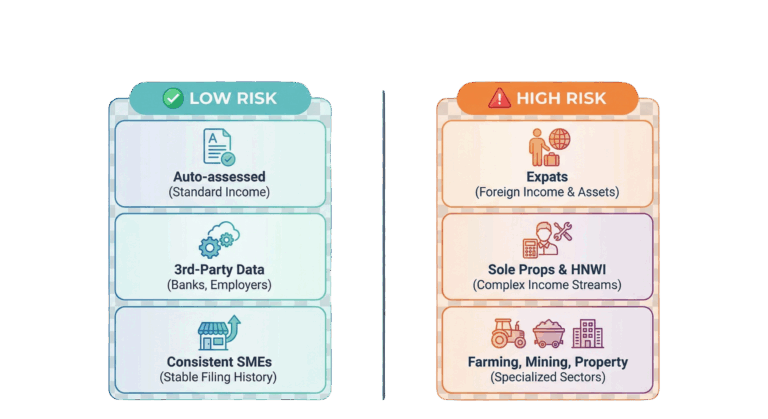
The big six red flags
- Lifestyle ≠ income
If declared income doesn’t match visible wealth (e.g., luxury assets on modest reported earnings), SARS pays attention.
Defuse it: Keep documentation on asset funding (e.g., loans, once-off capital gains, inheritances). Ensure CGT and other events are properly disclosed. - Frequent VAT refunds outside sector norms
Refund-heavy profiles make sense in farming/zero-rated outputs, mining pre-revenue, or property development during build phases. They’re unusual for professional services.
Defuse it: Maintain zero-rated outputs schedules, diesel rebate logs, and supplier VAT validations. Show the story: why this cadence fits your model. - Undeclared offshore income
South African residents are taxed on worldwide income; cross-border reporting (CRS) increases visibility.
Defuse it: Prepare a Section 6quat pack with foreign tax certificates, foreign tax year alignment, income source schedules, and exchange rate methodology. - PAYE inconsistencies
Examples include fictitious/duplicated IRP5s or manual manipulation of certificate counts.
Defuse it: Lock down HR/payroll data governance. Reconcile EMP201 → EMP501 → IRP5 totals. For ETI and voluntary over-deductions, keep written mandates and rule-based workings. - Late submissions and lots of corrections
Patterns of lateness and frequent “Request for Correction” filings suggest weak controls.
Defuse it: Implement a compliance calendar with internal cut-offs. Review your SOPs quarterly and stabilise the source data. - Hammering the eFiling calculator
Submitting repeated calculations in quick succession while changing figures can look like outcome-chasing.
Defuse it: Do your calculations offline. Use the eFiling calculator once to confirm the final numbers.
High-risk scenarios—and what “good” looks like
Sole proprietor claiming business expenses
- Risk: Expenses lack third-party validation; invoices may be weak.
- Good: Valid tax invoices tied to business use (telecoms, fuel, supplies), organised by supplier/month, and supported by payment evidence.
Assessed loss carried forward, but no trade this year
- Risk: Only passive income (e.g., interest) with no trading activity.
- Good: Demonstrate ongoing trade or pause the loss claim; document facts and apply the Act correctly for the year at hand.
Travel-heavy salary structures
- Risk: Excessive travel allowances relative to total remuneration; under-withholding PAYE.
- Good: Robust logbooks, clear business-travel substantiation, and allowance sizing that reflects reality.
Property development/mine with long pre-revenue phase
- Risk: Extended refund periods; large capital inputs; little to no outputs.
- Good: Capital vs trading inputs schedule, supplier VAT validation, project timeline, and any pre-sales contracts or milestones.
Importers/exporters
- Risk: Output/input mismatches; movement verification gaps.
- Good: Customs documentation, export proofs, and reconciliations tying customs declarations to VAT201 and revenue.
Your pre-filing anti-trigger checklist
- SIC sanity check: activities ↔ VAT treatment.
- VAT-to-revenue bridge: tie VAT201 to ITR14 revenue; explain timing/exempt/zero-rated differences.
- Payroll pack: GL ↔ EMP501/IRP5; ETI/over-deduction evidence.
- High-value supplier file: valid tax invoices; VAT numbers; proof of payment.
- Foreign income pack: 6quat certificates, schedules, tax years.
- Refund narrative: a short memo explaining refund patterns (sector context, projects, timing).
Response discipline matters
If a verification still lands, answer the question asked—no more, no less. Upload exactly the documents listed, in a clean order, with clear file names. Over-supplying often creates new questions.
Important Disclaimer
This material by Managing Advancing Wealth (Pty) Ltd (MAW) is general information only and not accounting, tax, legal, financial, or investment advice. Laws and guidance change over time; accuracy is not guaranteed. No liability is accepted for actions taken in reliance on it. No client relationship arises until MAW issues and you accept a Letter of Engagement. For advice tailored to your circumstances, please contact MAW.
Latest Posts
- Decoding SARS Risk Assessment (5 of 5)What’s Next (Tax Admin 3.0): AI Matching, VAT POS Integration & How to Future-Proof Your Practice SARS isn’t standing still. Expect sharper data matching, more real-time signals, and continued infrastructure upgrades aimed at stability during peak loads. For SMEs and… Read more: Decoding SARS Risk Assessment (5 of 5)
- Decoding SARS Risk Assessment (4 of 5)From Pre-Assessment Prompts to Post-Assessment Letters: Responding Right, Fast Even tight compliance can throw up a warning. The difference between a 10-minute fix and a 10-week headache is how you respond. Here’s a practical walkthrough—from the moment eFiling flashes a… Read more: Decoding SARS Risk Assessment (4 of 5)
- Decoding SARS Risk Assessment (3 of 5)Red Flags That Trigger Verifications—and How to Defuse Them Before You File Nothing spikes anxiety like a verification letter—especially during peak season. The good news? Most triggers are predictable. This article summarises the red flags SARS watches and gives you… Read more: Decoding SARS Risk Assessment (3 of 5)
- Decoding SARS Risk Assessment (2 of 5)Where SARS Gets Its Data—and the Cross-Tax Recons SMEs Must Nail SARS’s risk engine is only as strong as the data it ingests—and it ingests a lot. Understanding those sources (and how they cross-match) is the single best way to… Read more: Decoding SARS Risk Assessment (2 of 5)
- Decoding SARS Risk Assessment (1 of 5)Why a risk-based model at all? SARS manages millions of taxpayers across multiple tax types. Treating everyone the same would be inefficient and unfair. A risk-based model enables SARS to: In practice, your segment (who you are) and your behaviour… Read more: Decoding SARS Risk Assessment (1 of 5)
Ready to Transform Your Business?
If this article resonates with you, here’s how to get started
Start with Zoho Books
Get started with Zoho Books completely free, limited to 1000 invoices per year. Once you reach this limit, your business should be growing steadily and you can upgrade to the next tier.
Scale with Zoho One
Need an ERP system to bridge the gap with enterprise business? Zoho One provides incredible value and all the apps you require to take your business to the next level.
Both solutions grow with your business – start small, scale seamlessly